
2026 Midterm Candidate Questionnaire Responses
The housing shortage is a critical issue currently facing the citizens of Pittsburgh, Allegheny County, and Pennsylvania. We believe the solution to this crisis involves providing abundant and affordable housing for all. We fight for more housing because we want to reduce poverty, end homelessness, eliminate racial segregation, create jobs, and stop climate change, and we believe elected officials at every level play an important role in solving this crisis.
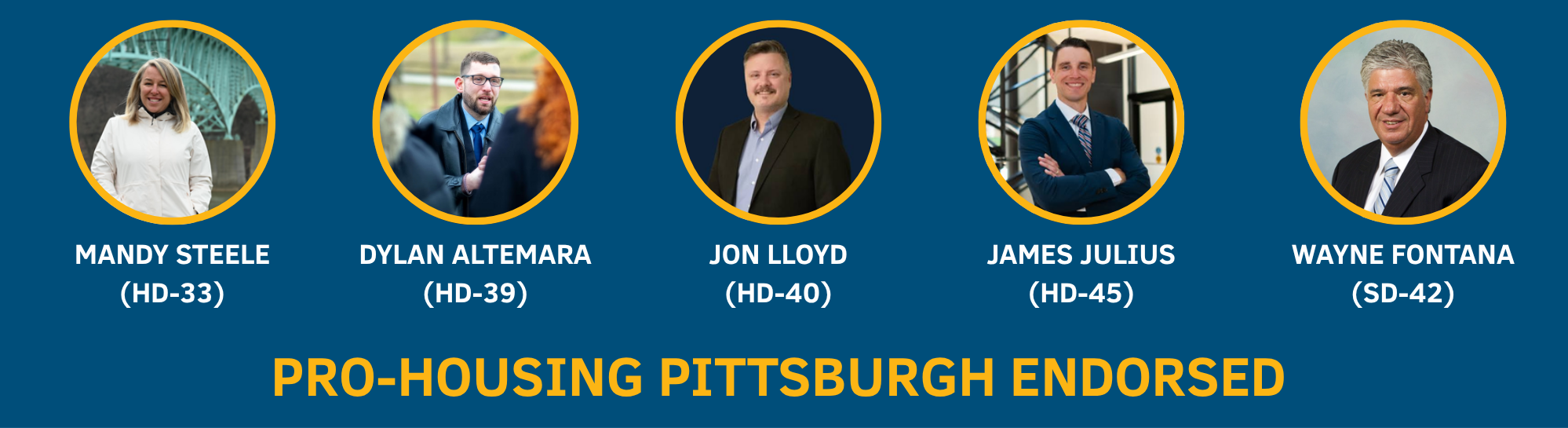
On November 3rd, 2026, midterm elections will take place across the country, including statewide elections in the Commonwealth of Pennsylvania. We sent questionnaires to every state legislative candidate running for office in Allegheny County, and received answers from the following candidates: Mandy Steele (HD-33), Dylan Altemara (HD-39), Jon Lloyd (HD-40), James Julius (HD-45), and Wayne Fontana (SD-42). All of their responses are published in full below, and informed our official endorsement of these candidates (among others) for the 2026 cycle.
Question 1: What has been your personal experience with housing in the Pittsburgh metro area? Do you rent or own? If you own your home, how long ago did you buy it? Have you or do you know others who have struggled to find affordable housing in the area?
Mandy Steele (HD-33):
I have lived in the Pittsburgh region my entire life, including many years in the Allegheny Valley, and I have seen firsthand how dramatically the housing market has changed. My family and I own our home (bought 10 years ago), and I understand how important stable, affordable housing is to families trying to put down roots in the communities they love. Across the Allegheny Valley, I have heard from relatives, friends, and neighbors who have struggled to find housing they can afford, whether they are looking to rent, purchase their first home, or remain in the community where they have lived for years. Rising home prices, higher interest rates, limited housing inventory, and increasing rents have placed real pressure on working families, young people, and seniors. We need to make sure the Allegheny Valley remains a place where people at every stage of life can afford to live and build a future.
Dylan Altemara (HD-39):
Housing is personal to me. As a teenager, my family experienced housing instability, and I experienced homelessness after a period of serious family medical and financial hardship. Today, I co-own a home with family in the Mon Valley and have lived there for more than four years. I also know families who are being squeezed by rising rents, higher home prices and interest rates, property taxes, insurance, and the cost of maintaining older homes. First-time buyers face limited affordable inventory, while seniors and working families can feel trapped between rising costs and the desire to remain in the communities they helped build. Those experiences are why I view stable, affordable housing as basic economic security, not a luxury.
Jon Lloyd (HD-40):
Our family rented in Bethel Park for four years, then became first time homebuyers in 2019. When searching for a home, we ended up having to stretch our budget to find a home that would be suitable for a family of five, and have seen property and/or school tax increases regularly since. I know many parents of adult children who are simply unable to find affordable housing in the district due to skyrocketing costs while wages remain stagnant. We are losing the opportunity to house young families to other neighboring districts, and I want to work to make our district a place where people can not only live, but afford to stay.
James Julius (HD-45):
My wife and I own our home in Robinson Township, where we are raising our four children. We previously owned another home and rented for a couple of years before becoming homeowners.
Having rented and owned, I understand that housing costs extend beyond the rent or mortgage payment. Taxes, utilities, insurance, and repairs all affect whether a home is affordable. As a father, I also think about whether our children will have a realistic opportunity to buy their first home and build their lives in this region.
Wayne Fontana (SD-42):
I have owned my Brookline home for over 40 years. I also own several rental properties across the region.
Question 2: While Pittsburgh is often cited as one of the least expensive major metro areas in the country, housing prices have increased significantly in the area since 2020. What do you see as the largest contributing factors to the housing crisis in the Pittsburgh region? What policies would you support to fix these causes? What evidence do you have that these policies would work?
Mandy Steele (HD-33):
One of the biggest factors I see is the growing role of corporate investors and private equity in the housing market. When large investors purchase single family homes, they can compete directly with first time homebuyers and working families, driving up prices and turning homes that could build generational wealth into long term rental properties. At the state level, I would support greater transparency around corporate ownership of residential properties, stronger protections for homebuyers, and legislation that examines additional taxes or fees on large scale corporate purchases of single family homes. At the same time, Pennsylvania needs to increase the supply of affordable housing and preserve the homes we already have. I support continued investment in programs like Whole-Home Repairs, assistance for first time homebuyers, and state funding that helps communities build and rehabilitate affordable and workforce housing. Solving the housing crisis requires addressing corporate investors and private equity while also making it easier for working families to buy, maintain, and remain in their homes.
Dylan Altemara (HD-39):
The problem is not one single factor. We build too little housing where people want and need to live; we have an aging housing stock that is expensive to repair; zoning and permitting barriers that slow and raise the cost of new construction; and too few units affordable to lower- and middle-income households. Pennsylvania's 2026 Housing Action Plan projects that the Commonwealth will need 450,000 additional homes by 2035 and, at the current pace, will fall short by roughly 185,000. Pittsburgh's own housing planning work has also identified a shortage of affordable units and the need to both add newsupply and preserve existing homes.
I would support a balanced supply-and-affordability strategy: expand PHARE and housing-rehabilitation funding; help first-time homebuyers with closing costs and attainable-homeownership programs; encourage infill, redevelopment of vacant and blighted property, accessory dwelling units, and appropriately scaled multifamily housing; streamline predictable permitting without weakening safety or environmental standards; and give municipalities technical assistance to modernize zoning where local rules unnecessarily prevent housing. I also support property-tax relief for qualifying seniors and working families so that building new housing does not come at the expense of displacing existing residents.
The evidence points toward using multiple tools together. State housing data show a substantial supply gap and an aging housing stock, while Pittsburgh's Housing Needs Assessment and subsequent zoning work identify regulatory barriers, affordability gaps, and displacement pressures. Programs such as PHARE have also financed the creation or rehabilitation of thousands of affordable homes statewide. The lesson is that Pennsylvania needs to build more housing, preserve what we already have, and directly support households that the market alone will not adequately serve.
Jon Lloyd (HD-40):
I believe the region’s crisis is driven largely by a shortage of affordable housing, rising costs of construction, restrictive zoning, and earned wages that haven’t kept up to the pace of housing expenses. Also, there are a lot of aging homes in our region that require expensive repairs that families just can’t afford. In my opinion, this needs to be fixed from two angles: increasing the supply of housing and the ability of working families to afford it. I would support removing zoning barriers to allow more duplexes, townhomes and multifamily housing, especially near public transit. I would expand investment in affordable housing and incentivize builders who build affordable starter homes. I would also support funding for PA’s Whole Home Repair Program so that we can preserve our existing homes. The research shows that this program has already helped families across the county to address needed, many times unaffordable, home repairs. It’s also a fact that more housing construction slows the growth of renters.
James Julius (HD-45):
We don’t have enough starter homes, and many of the homes we do have need significant work. A lower purchase price doesn’t help much if you can’t afford the repairs needed to live there.
I support making it easier to build starter homes and fix up older ones. That includes faster permits, fewer unnecessary hurdles, and help with needed repairs. Research on new apartment construction has shown that adding housing can help bring down nearby rents. We need more supply, and fixing up existing homes needs to be part of that effort.
Wayne Fontana (SD-42):
We certainly have a low housing stock in the region. I applaud the efforts to address the affordable housing needs and have advocated for state funding for many of those projects. I also believe that only focusing on affordable housing will not fully address the problem. We also need new builds for single-family, townhomes, condos, and luxury homes.
Question 3: Reps. David Solomon, John Inglis, and Greg Scott have recently proposed several bipartisan bills intended to combat Pennsylvania’s housing shortage. These bills will, among other things, prohibit municipal parking minimums, streamline the processing of housing-related permits, and define pre-approved housing plans. The specific language of each bill can be found in the links below:
https://www.palegis.us/house/co-sponsorship/memo?memoID=47700
https://www.palegis.us/house/co-sponsorship/memo?memoID=47775
https://www.palegis.us/house/co-sponsorship/memo?memoID=47776
https://www.palegis.us/house/co-sponsorship/memo?memoID=47774
https://www.palegis.us/house/co-sponsorship/memo?memoID=47550
If elected, will you commit to supporting this legislation?
Mandy Steele (HD-33):
Yes, I will.
Dylan Altemara (HD-39):
Yes. I support the direction of this bipartisan housing package and would support these proposals, provided the final legislative language preserves appropriate public-safety, accessibility, labor, infrastructure, and environmental standards. Pennsylvania needs more housing, and unnecessary parking mandates, unpredictable permitting delays, and duplicative design processes can add cost and make otherwise viable housing harder to build. I also believe implementation should respect legitimate differences among communities and give municipalities the tools and technical support they need to plan for infrastructure and growth. My goal would be to remove unnecessary barriers while protecting residents and ensuring that new development strengthens the communities where it is built.
Jon Lloyd (HD-40):
I will certainly commit to supporting these and other bills that are designed to make housing more accessible and affordable.
James Julius (HD-45):
I support making it easier to build housing, including faster permits and plans that can be approved ahead of time. I also support giving people more options for the kinds of homes they can build and buy.
I would need to review each bill before promising a yes vote on all of them. Parking and infrastructure needs vary by community, and those details matter. But I’m willing to work with either party to remove unnecessary barriers and get more homes built.
Wayne Fontana (SD-42):
Yes, I support the legislative intent of each of these bills.
Question 4: The current property tax system is structured to benefit wealthier incumbent homeowners to the detriment of newcomers, young families, and the working class. If elected, would you support a shift toward regular and equitable property tax assessments?
Mandy Steele (HD-33):
Yes, I would.
Dylan Altemara (HD-39):
I support a property-tax system that is accurate, transparent, and equitable, but reform has to protect people from being taxed out of their homes. Long gaps between reassessments can create major inequities between similar properties and can place a disproportionate burden on recent buyers. At the same time, a sudden reassessment can create unaffordable spikes for seniors, working families, and people on fixed incomes.
I would support moving toward a more regular and uniform assessment system if it is paired with strong taxpayer protections: expanded homestead relief, a stronger Property Tax/Rent Rebate program, protections for qualifying seniors and working families, reasonable phase-ins or circuit-breaker mechanisms, and greater state support for public education so local school districts are less dependent on property taxes. Fair assessments and meaningful homeowner protections should go hand in hand.
Jon Lloyd (HD-40):
Yes, I would support regular assessments that ensure homeowners are essentially taxed fairly based on the actual value of their properties. Right now, the system has a tendency to put an unfair burden on new homeowners and young families but allow properties with similar values to be taxed at very different rates. I also believe these assessment reforms should include protection for seniors and low- and fixed-income families so that when taxes go up, people aren’t forced out of their homes.
James Julius (HD-45):
Yes. Assessments should be fair, consistent, and easy to understand. People should be able to budget for their property taxes without being blindsided. I support regular assessments, a straightforward way to challenge mistakes, and adjusting tax rates so reassessment doesn’t become an excuse to collect more money overall. We also need to protect people who could be priced out of their homes by a sudden increase.
Wayne Fontana (SD-42):
I have introduced Senate Bill 567, which would require counties reassess at least once every five years. Regular assessments have been a policy priority of mine since I was an Allegheny County Council member in early-2000s.
Question 5: In Pennsylvania, municipalities of second class cities and below can set separate tax rates on land and buildings. Taxing land at a higher rate than buildings incentivizes growth, penalizes sprawl, and prevents absentee landlords from profiting off blight. Would you be in favor of expanding this power to first class cities, counties, and school districts?
Mandy Steele (HD-33):
Yes, I would.
Dylan Altemara (HD-39):
I would support expanding this as a local option rather than imposing it as a statewide mandate. A split-rate or land-value approach can incentivize putting vacant or underused land to productive use and reduce the tax penalty associated with improving a property. Pennsylvania also has a long history with this model, including in Pittsburgh.
However, tax policy can have different effects depending on local land values, development patterns, and the fiscal needs of a county or school district. Any expansion should include transparent modeling, protections against unintended tax shifts onto homeowners or small businesses, and local public input before adoption. I am open to giving communities another tool, but it should be used carefully and with clear safeguards.
Jon Lloyd (HD-40):
I would because a higher land tax could reduce the tax burden on existing properties. These municipalities should have the ability to determine whether this is appropriate locally versus being prohibited from even considering it.
James Julius (HD-45):
I’m open to it, but I would want to see what it means for people’s actual tax bills. Encouraging someone to fix up a property makes sense. Before expanding this, though, I’d want to know who pays more, who pays less, and whether it helps get homes built or repaired. I’m not ready to give a blanket yes without those answers.
Wayne Fontana (SD-42):
Yes. We have seen the benefits of this authority in the Pittsburgh region and believe that Philadelphia should be able to make their own local decisions if they chose.
Question 6: What books, articles, or research have you read that have informed your views on housing?
Mandy Steele (HD-33):
I would not point to one specific book or body of academic research that has shaped my views on housing. Instead, I regularly follow housing issues as they arise through local and national reporting. I read Pittsburgh area publications to understand the challenges families are facing here in our region, as well as national outlets like the New York Times and Washington Post.
Dylan Altemara (HD-39):
My views are informed less by a single book than by public data, housing-needs research, and the experiences of people in our communities. The research I rely on includes Pennsylvania's 2026 Housing Action Plan and related Department of Community and Economic Development materials; the City of Pittsburgh Housing Needs Assessment and the City's work on zoning, accessory dwelling units, parking, and affordable housing; Pennsylvania Housing Finance Agency information on PHARE and housing production and rehabilitation; and research on land-value taxation and Pennsylvania's experience with split-rate taxation. I also pay close attention to local school-funding and property-tax data because housing affordability is inseparable from the tax burden placed on homeowners and renters.
Jon Lloyd (HD-40):
The Pew Charitable Trusts, PA’s Whole-Home Repair Program, Ezra Klein – “Why Housing is So Expensive – Particularly in Blue States”, existing and prior legislative agendas
James Julius (HD-45):
My preparation has focused on Pennsylvania’s older homes, the shortage of available housing, and the costs people face when buying or making repairs. That has included information about Whole-Home Repairs, PENNVEST’s homeowner sewage program, and sewer issues covered by 3 Rivers Wet Weather.
What matters to me is whether a proposed solution will make it easier for someone to afford and maintain a home.
Wayne Fontana (SD-42):
I am informed by my career as a real estate broker, my years of serving on housing and redevelopment boards, and my decades of public service as a county councilmember and state senator.
Question 7: Do you have any other thoughts on housing that you would like to share with the voters of your district?
Mandy Steele (HD-33):
N/A
Dylan Altemara (HD-39):
Housing policy has to recognize that affordability looks different across the Mon Valley and South Hills than it does in Pittsburgh's fastest-growing neighborhoods. In HD-39, the challenge is not only building new homes. It is also helping people repair older homes, bringing vacant and blighted properties back into productive use, creating realistic opportunities for first-time buyers, supporting quality rental housing, and making sure seniors can remain in the homes they worked a lifetime to afford.
I also believe housing policy should support good jobs. When public dollars fund major housing and infrastructure projects, we should expect responsible contractors, safe workplaces, prevailing wages where applicable, and strong apprenticeship pathways. We can increase housing supply and affordability while also strengthening the local workforce and tax base.
Jon Lloyd (HD-40):
Housing affordability to me is about more than just paying a mortgage or rent. It’s about whether families can afford to put down roots in their communities. As a father of three, I know how important a stable, affordable home is to a family’s future.
James Julius (HD-45):
We need to make it easier to buy, build, and fix up a home.
One issue I’ve raised is the cost of repairs required after a dye test when someone is selling a house. Those tests are important, but the repair bill can be a real obstacle for the buyer or seller. I support state programs that help people pay for that work. Addressing practical problems like this should be part of making housing more affordable.
Wayne Fontana (SD-42):
We have some of the oldest housing stock in the country, so if we want to grow as a region (and we do!) we need to get creative with our ordinances and incentives. Investing in policies that work and leaving behind ones that don’t.
Question 8: The suburbs and exurbs of Pittsburgh are experiencing rapid growth, as is the case around the country. In some suburban areas, community groups have expressed concern about the environmental impacts of suburban and exurban sprawl. What policies would you propose to help strike a balance between the need for new housing and protecting the local environment?
Mandy Steele (HD-33):
We need to build more housing, but we should be thoughtful about where and how that development occurs. I would support state policies that encourage new housing in areas that already have infrastructure, transportation, and existing development, including older communities throughout the Allegheny Valley.
Pennsylvania should also continue investing in the reuse of underutilized properties rather than allowing development to continually push into farmland, forests, and open space. I also support giving municipalities more resources for responsible planning, stormwater management, and environmental protection.
Dylan Altemara (HD-39):
We should grow in a way that uses land and infrastructure responsibly. I would prioritize infill development, redevelopment of vacant and blighted sites, brownfield reuse, and housing in places that already have roads, water, sewer, schools, and other public infrastructure. That can add homes without pushing every new development farther into undeveloped land. I also support giving communities tools to allow a broader mix of housing types in appropriate areas so that meeting housing demand does not automatically mean consuming more land.
At the same time, new development should account for stormwater, flooding, drinking-water protection, traffic, sewer capacity, open space, and habitat. State infrastructure and housing dollars should reward projects that reuse existing sites, remediate contaminated land, protect sensitive areas, and incorporate resilient stormwater practices. The choice should not be between housing and the environment. Good planning can produce more homes while preserving the natural resources and quality of life that make our communities desirable in the first place.
Jon Lloyd (HD-40):
This is something I’ve heard here locally in our suburban district. I think there is a balance where we can expand housing opportunities while at the same time protect the natural resources that make our communities so desirable. We can achieve this through things like zoning reforms that encourage more housing in developed areas, stronger stormwater management, and more green spaces. In the communities in the 40th district, special attention needs to be made of how new development affects traffic, waterways and flooding. We shouldn’t have to make a choice between responsible, affordable development and the health of our environment.
James Julius (HD-45):
We should make better use of vacant properties and fix up existing homes, especially where roads, water, and sewer service are already in place. We should also make room for smaller homes and other housing options that don’t require large lots. When new housing is built, we need to address drainage, sewer capacity, and traffic up front. Neighbors deserve a say, and developers should be responsible for the costs their projects create. We need more homes, but we also need to take care of the communities around them.
Wayne Fontana (SD-42):
The PA Supreme Court has been very clear in opposing state pre-emption of locally-adopted ordinances. The state government must respect the authority of local officials and municipalities. However, the state can serve as a valuable clearinghouse for model ordinances and resource consulting, working in cooperation with statewide advocacy groups like PSATS, CCAP, and PA Environmental Council.