On November 4, 2026, the Pittsburgh Historic Review Commission found reasonable cause that the Hefty House individual landmark at 624 East Ohio Street no longer meets its designation criteria and gave City Council a positive recommendation to revoke that designation. Commissioners also took briefings on façade repairs at Perry High School and on updated Manchester / Mexican War Streets design guidelines. Here’s what happened.
Recording: https://www.youtube.com/watch?v=5GxEYLagI4E
Hearing and Action
DCP-HN-2026-00212 — Hefty House, 624 East Ohio Street (East Allegheny / Deutschtown)
City materials: Revocation packet · Revocation presentation · Original 2018 nomination · Meeting agenda
Summary of Case
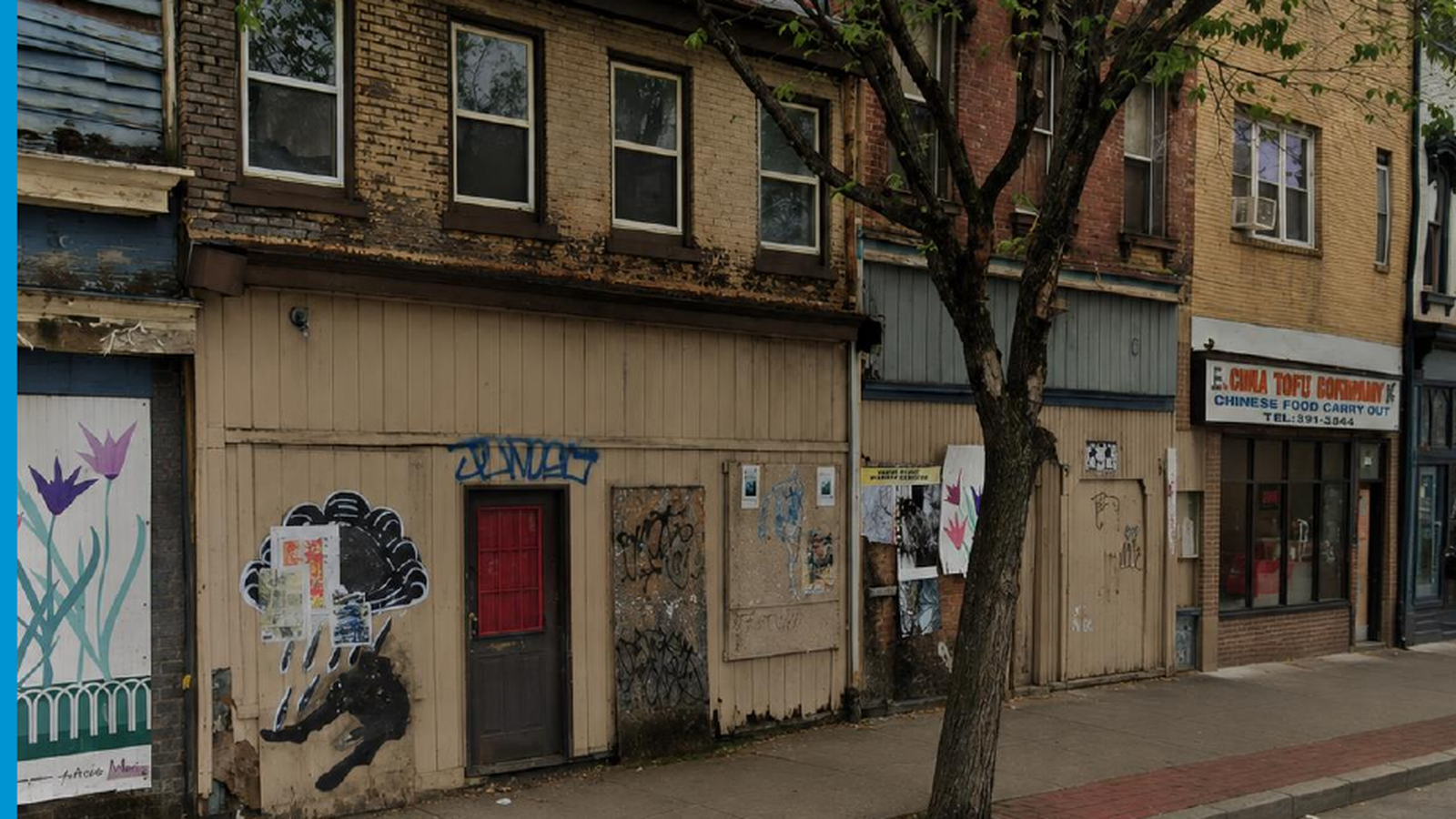
Revocation of the individual landmark designation for the Hefty House at 624 East Ohio Street, a 2.5-story wood-frame building with a brick façade in East Allegheny / Deutschtown, originally associated with Swiss immigrant saddler Jacob Hefty and nominated in 2018 under criteria 3 (architectural significance / modest Greek Revival), 8 (pattern of neighborhood development), and 10 (physical appearance as a familiar visual feature). City Planning staff (Sharon Spooner) said the same §1101.03 designation process is used in reverse for revocation: the commission first decides whether reasonable cause exists that the landmark no longer meets the criteria, then makes a positive or negative recommendation to City Council. Staff agreed with the application that the property no longer meets criteria 3, 8, and 10 and has lost integrity of design, materials, and workmanship.
URA project manager Gordon Hall and civil engineer Wais Baheen presented for the applicant. The URA has owned the vacant building since 2005 (City ownership 1998–2005). Two public RFPs in 2016 and 2021 did not yield a viable project; a 2025 structural review by Brace Engineering found roughly 80% of the second floor needing replacement, a ~12-foot collapse at a rear reentrant corner, roof/gutter failures, and restoration cost exceeding rebuild value, with all work forced through the street face. The building carries PLI prohibited-occupancy / unfit-for-occupancy citations. The URA held a Development Activities Meeting with East Allegheny Community Council on September 8, 2026, and said EACC supported removing the designation. Staff recommended both the reasonable-cause finding and a positive recommendation to Council.
Discussion
In-person: Nick Kyriazi (517 Avery Street) opposed revocation. He argued the building still meets the original criteria, estimated ~$164,000 (2024) to restore the façade and structure, said a preservation-minded developer is willing to buy if the City addresses nearby homeless encampments, and later clarified that scaffolding for falling brick concerned 628 East Ohio, not 624. Sarah Bailey, president of East Allegheny Community Council, supported removing the designation, citing the September community meeting.
Online: Anna Samuels, archivist/librarian speaking for Pittsburgh History & Landmarks Foundation, opposed delisting and planned demolition, citing continuity of scale on East Ohio Street and the Deutschtown National Register commercial row, and offered to work with URA and others on alternatives. Melissa McSwigan of Preservation Pittsburgh also opposed, arguing the current ordinance lacks a clear delisting process, questioning what integrity was lost since the 2018 designation under URA ownership, and warning about precedent. Dennis Ginther, who had submitted correspondence, could not be promoted to speak on Zoom; staff offered to take a written comment afterward.
Commissioners described it as a difficult, unusual case. Chair Luna Fruensgaard said the HRC’s focus is the exterior façade and dilapidated condition, that the decision is case-by-case rather than a blank check for future revocations, and that she saw cause for the request. Other commissioners echoed how hard the call was given years of vacancy. Marti Isler asked by chat whether the building is a health and safety threat; the URA said yes (sidewalk protection scaffolding last winter; structural engineer findings; ongoing PLI citations and public-safety costs). Hall said decorative boarding/painting had been done and had since deteriorated, that most historic character was already gone before nomination, and that ARPA (2021) and Main Street Matters grant applications for stabilization were unsuccessful. Public comment was closed before a brief clarifying remark from Kyriazi about the scaffolding.
Decision
Two motions, both approved on roll call:
1. Reasonable cause that the landmark no longer meets the criteria for designation — motion by K. Chase Patterson, second by Luna Fruensgaard. Ayes: Catherine Blauvelt, Luna Fruensgaard, K. Chase Patterson, Marti Isler, Ivette Mongalo-Winston. 2. Positive recommendation to City Council on revocation of the historic designation — motion by K. Chase Patterson, second by Catherine Blauvelt. Same five commissioners recorded as approving.
(Helen Cestra answered present at roll call; David Green was called and did not clearly answer. Neither appears in the recorded roll-call votes.)
Also on the Agenda
Minutes and Certificates of Appropriateness Report
October 7, 2026 minutes approved (motion Blauvelt, second Patterson; Isler joined during/after this item). Certificates of Appropriateness report approved (motion Blauvelt, second Patterson).
Correspondence / Public Comment
Correspondence on the Hefty House case from East Allegheny Community Council and Dennis Ginther. Off-agenda correspondence noted for BDA-2026-09573 (window/sill replacement at 1222 Palo Alto). No other public comment on non-hearing items (one online speaker held for the Hefty House hearing).
Director’s Report
None.
Briefing — Perry High School, 3875 Perrysville Avenue (Perry North)
City materials: Presentation
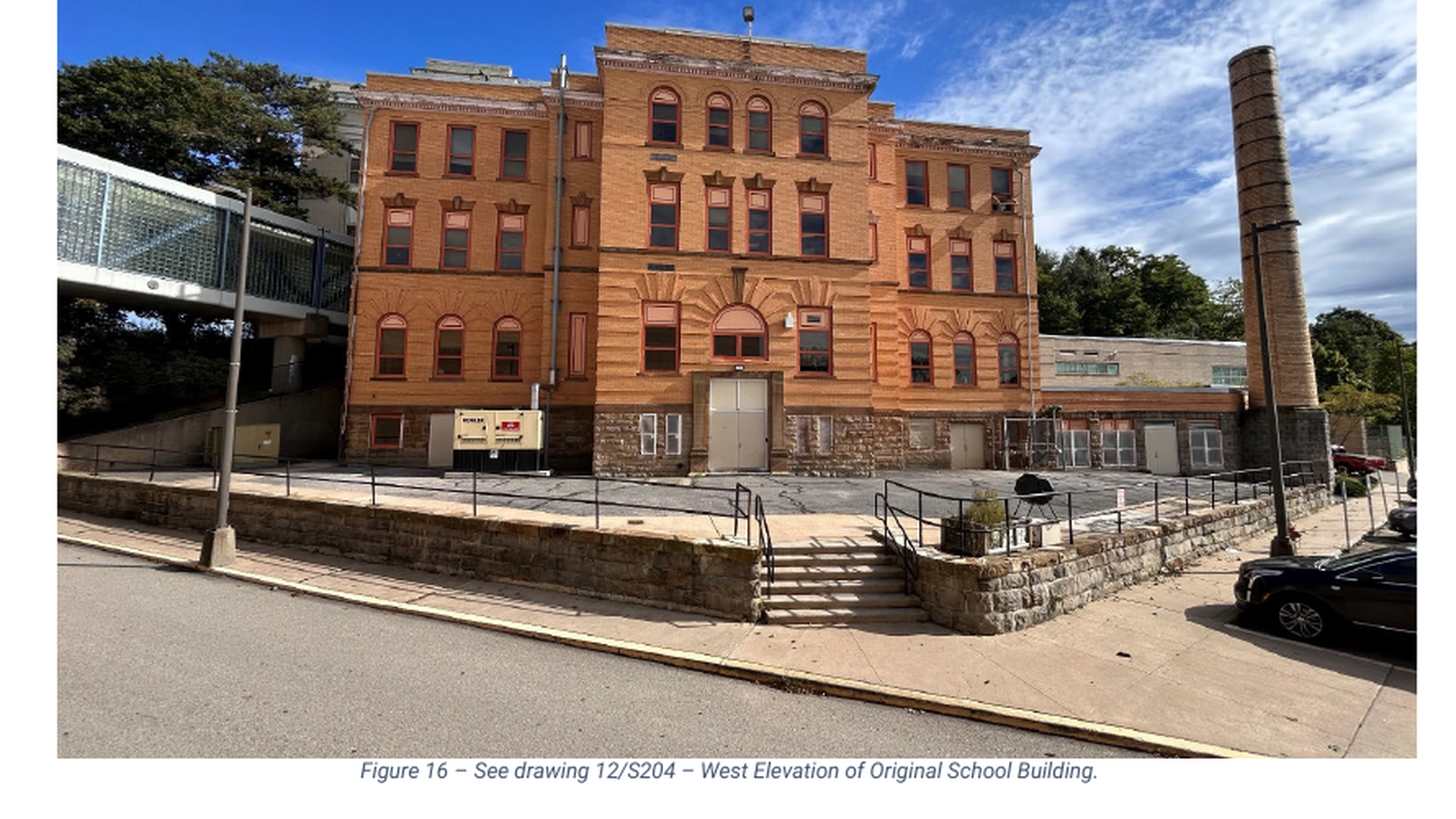
Individual landmark. City Planning staff Mary Grace Collins introduced a façade-repair Certificate of Appropriateness briefing for Pittsburgh Public Schools. A building permit application is still pending; a Development Activities Meeting will be scheduled before hearing and action. Review criteria include the Pittsburgh Public Schools preservation and design guidelines (including substitute materials when in-kind replacement is not technically or economically feasible), City code, and the Secretary of the Interior’s Standards.
Architect Joseph Filar of PWWG Architects described phased exterior work over as many as four years: masonry cleaning/repointing, concrete and retaining-wall repairs, wood cornice repairs, and replacements of failing plaster cornice (~500 linear feet on the 1921 Perrysville Avenue wing) with fiber-reinforced plastic (FRP) molded to match, plus glass-fiber reinforced concrete (GFRC) for deteriorated terracotta at a stair-bridge arch on Hemphill Street, with stainless-steel anchorage. Commissioners asked whether the terracotta arch would be replaced in full (applicant: remove compromised units and failing anchors, replace with color-matched GFRC) and about glaze/finish (satin / integral color, not painted). No public testimony at briefing; hearing and action still to come.
Briefing — Manchester & Mexican War Streets Design Guidelines and Hierarchy of Facades
City materials: Presentation
Staff briefed the latest CLG-funded update to design guidelines for Manchester and the Mexican War Streets (general citywide guidelines plus district-specific documents), informed by community input on affordability, accessibility/sustainability, enforcement consistency, and treating rear/hidden façades differently from street fronts. Hierarchy of façades: primary (full HRC review), contributing secondary (full HRC review), non-contributing secondary (HRC for new construction; staff for alterations/alternate materials), and non-visible (staff). Proposed shifts include allowing durable modern substitutes that match appearance, solar-panel guidance (flat, reversible, neat, hide when possible; caution on character-defining roofs), and new construction that is “compatible but distinct” in mass and scale. Mexican War Streets Expansion guidelines are to be aligned and brought back with Manchester, targeted for December hearing and action. Chair Fruensgaard asked whether “compatible but distinct” language might discourage high-quality traditional new construction that emulates the district; staff said they would clarify wording and send full draft documents for commissioner review.
Adjournment
Motion to adjourn by Catherine Blauvelt, seconded, and carried.
Summary prepared with the assistance of AI from the public YouTube recording. This is not an official City of Pittsburgh record.