Urban Redevelopment Authority Board Meeting Summary - October 8, 2026
On October 8, 2026, the Urban Redevelopment Authority of Pittsburgh (URA) Board of Directors adopted the East Liberty TRID Phase III plan to help finance Walnut Capital’s Bakery Square expansion at Penn and Shady. The board also opened six-month exclusive negotiations on four sites: 200 Ross Street downtown, two groups of City-owned lots in Allentown, and 90 parcels along Herron Avenue in the Middle Hill. It approved a $980,000 grant for eight affordable for-sale homes in Larimer. All five board members were present, and every item passed on a voice vote with no audible opposition. Here’s what happened, item by item.
Recording: https://www.youtube.com/watch?v=LMN48xJeekE
Development Services
200 Ross Street — John P. Robin Civic Building (Downtown)
URA materials: Director’s report and resolution
In the news: URA working with Beacon to redevelop Robin Building downtown after another firm drops plans — Pittsburgh Business Times, Oct. 6, 2026.
Summary of Item
The board was asked for six months of exclusive negotiations with Beacon Communities on the sale of the URA’s former headquarters at 200 Ross Street. Beacon plans to turn the 13-story building, the 1908 Jones & Laughlin Steel headquarters, into 88 mixed-income apartments: 65 affordable and 23 market-rate. Financing would come from 9% low-income housing tax credits (LIHTC), historic tax credits, and a mortgage. The ground floor would hold management offices and common space, and the 13th-floor former URA boardroom would become community space. The slide shown at the meeting put the total development cost at about $48.9 million.
Discussion
Beacon’s Michael Polite was having trouble joining online. Zober said few developers can turn vacant downtown office buildings into housing, especially affordable housing, and thanked Beacon for taking on the building. He noted later in the meeting that the project will still have a funding gap after its tax credits. No public comment.
Decision
Approved: six months of exclusive negotiations. Voice vote, with a motion and second heard (movers not identifiable on the recording); no opposition was heard.
East Liberty Transit Revitalization Investment District (TRID) — Phase III (East Liberty / Larimer)
URA materials: Phase III Implementation Plan · Director’s report and resolutions
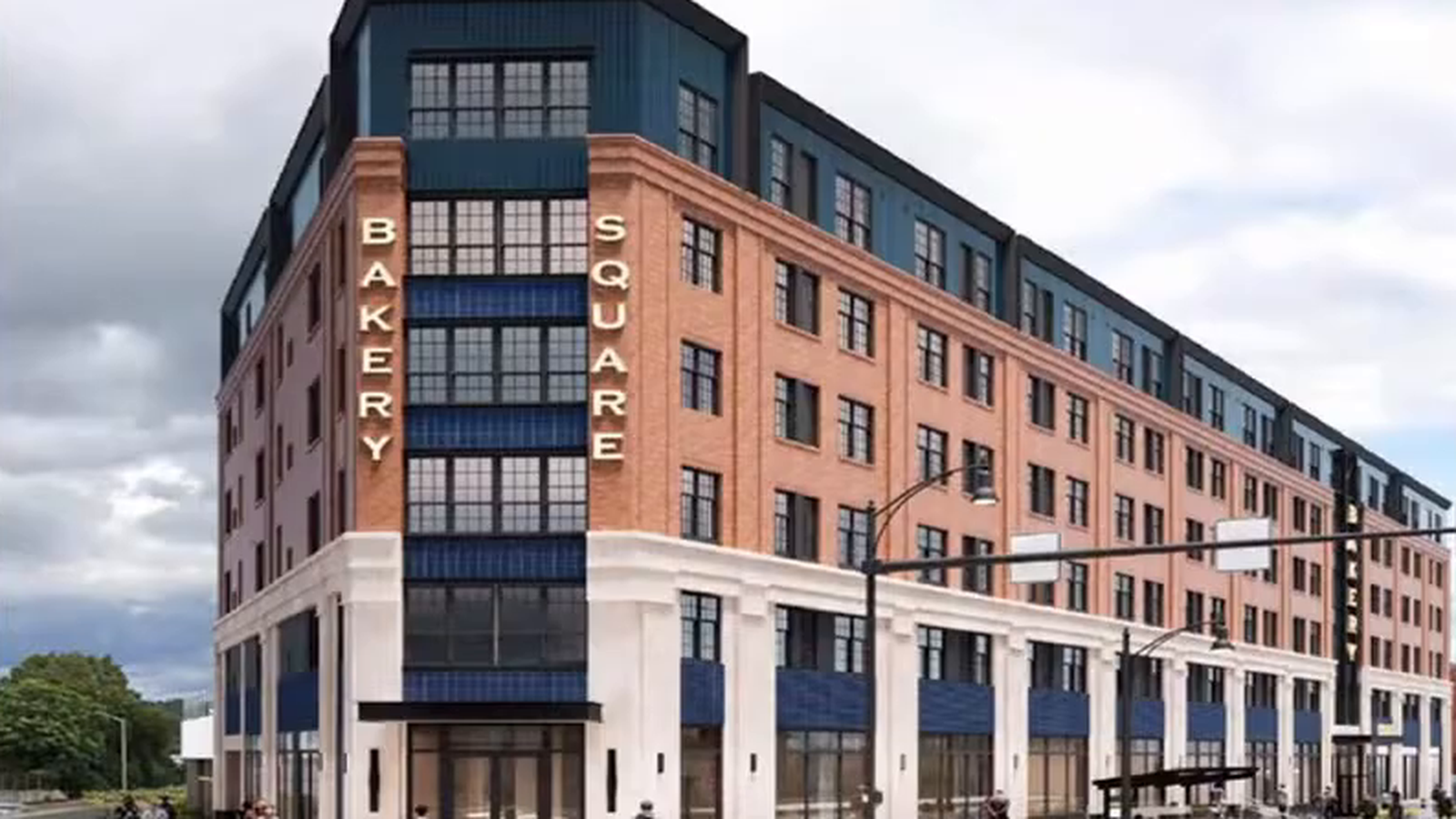
In the news: Walnut Capital eyes new apartments for Bakery Square expansion — PublicSource, June 16, 2026. Pittsburgh planners approve new East Liberty apartments — 90.5 WESA, July 1, 2026.
Summary of Item
The board was asked to adopt the Phase III implementation plan for the East Liberty TRID, pledge nine parcels, and enter into related agreements. A TRID borrows against future increases in property taxes from new development to pay for public infrastructure around a transit station. Phase III covers two Walnut Capital sites next to Bakery Square. Phase A, on the former Club One site at Penn and Shady avenues, is a six-story building with 199 apartments and about 5,000 square feet of office space. Five percent of the apartments will be affordable to households at 80% to 120% of area median income (AMI). Phase B would redevelop the Eastside Village Shopping Plaza with hotel, retail, residential, and possibly office uses. The plan puts the total cost of both phases at about $180.6 million.
Under the plan, 70% of the new property taxes would go to the TRID for 20 years, and the City, County, and school district would keep the other 30%. That is projected to raise about $10.07 million in net proceeds. The money would pay for public realm improvements ($3.12 million), brownfield cleanup ($2.18 million), new signals, crosswalks, and road work on Penn and Shady ($2.12 million), and stormwater management ($1.54 million). It would also put $1 million toward housing-related site work elsewhere in the TRID and $100,000 toward a Pittsburgh Regional Transit study of the East Liberty garage and Larimer station. The nine parcels are assessed at about $16.6 million today and are projected to reach about $85 million.
Chief Development Officer Tom Link recapped the first two phases. The parcels pledged in Phase I (2013) have grown from about $7 million to about $142 million in assessed value, and the Phase II (2015) parcels from about $10.9 million to about $112 million. The City, County, and school board still have to approve the plan, with votes scheduled for November 2026 through January 2027.
Discussion
Before the vote, the board heard public comment in support from Steve Mazza of the Eastern Atlantic States Regional Council of Carpenters, the business manager of a Laborers’ union local, and Diana Davis of the Larimer Consensus Group. They pointed to the union general contractor (PJ Dick), the apprenticeship pathways, and the 2023 community benefits agreement. Davis said that agreement includes a goal of building and selling 100 homes in Larimer, along with job training and traffic and sidewalk safety work on Penn Avenue. A Fair Housing Partnership speaker asked whether the affordable units would accept Housing Choice Vouchers and whether tenant screening rules could be discussed.
John Kamin, speaking for Walnut Capital, said Phase A is ready to go and waiting on its building permit, with opening planned for spring 2028. He said the original pre-pandemic plan for Phase B, more than a million square feet of offices, no longer works, so Phase B is now expected to be retail-focused with a hotel, no office, and possibly more housing. Trader Joe’s will stay. Director Sam Williamson asked for more detail on Phase B and on the community benefits agreement. Kamin said 10% of the TRID money will go to housing site work in East Liberty and Larimer, planned with the Larimer Consensus Group. State Rep. Lindsay Powell credited URA staff and said few places in Pennsylvania can run a TRID at this scale. Chair Yarone Zober spoke at length about how Bakery Square’s 2006 tax increment financing (TIF) deal turned a vacant Nabisco plant into a major job center. His argument was that projects like this “do not happen” without public-private tools.
Decision
Approved on a voice vote; no opposition was heard. The chair called the vote before anyone had made a motion. A board member then pointed out that no motion had been made, but the recording doesn’t clearly show one being added afterward.
In the news: Back to retail: Walnut Capital gets TRID vote for $158M Bakery Square Connector redevelopment — Pittsburgh Business Times, Oct. 8, 2026.
Allentown Scattered Sites — Module Design (three City-owned lots)
URA materials: Director’s report and resolution
Summary of Item
The board was asked for six months of exclusive negotiations with Module Design on three City-owned lots on Climax Street (Block 14-E, Lots 214, 231, and 232). These came out of the URA’s June 2026 request for proposals for scattered vacant lots in Allentown. The concept shown has four three-bedroom modular homes for sale, built as two semi-detached buildings. The design and cost will be worked out during negotiations.
Discussion
Julie Nigro of Module said the company builds energy-efficient homes in its Carnegie factory on hard-to-develop infill lots. Councilmember Bob Charland, whose district includes Allentown, said he hopes this is the first of many projects bringing new neighbors to the Hilltop. He said he had toured Module’s factory and called it “the future of home building.” A board member recalled the board’s earlier Module approvals in Garfield and called the approach potentially nationally significant. Zober said almost all of the roughly 20 parcels the URA offered in Allentown got proposals.
Decision
Approved on a voice vote; no opposition was heard. The motion appears to have come from the board member who spoke about Garfield (inferred). Someone seconded, but it isn’t clear who.
Allentown Scattered Sites — RE360 (seven City-owned lots)
URA materials: Director’s report and resolution
Summary of Item
The board was asked for six months of exclusive negotiations with RE360, an Allentown-based real estate company, on seven City-owned lots on Manton Way and Climax, Industry, and Millbridge streets. The lots are next to or near property RE360 already owns. RE360 plans four multi-car parking pads that would also host community events. Estimated cost is about $154,000, paid in cash.
Discussion
RE360’s director of operations said the company sees itself as a community developer. He said it sponsors the Allentown Night Market and lends its lots for food drives, and that more parking will be needed as new housing like Module’s arrives. Charland supported the proposal. Zober acknowledged that “we might not love the idea that parking lots exist” but said the lots support the business district and are better than weedy vacant parcels the public pays to maintain.
Decision
Approved on a voice vote; no opposition was heard. A motion and second were heard, but the speakers can’t be identified.
Middle Hill District — Herron Avenue Housing Assemblages, Phases I & II
URA materials: Director’s report and resolution
In the news: New York developer proposes four-phase multifamily project in the Middle Hill — Pittsburgh Business Times, Oct. 8, 2026.
Summary of Item
The board was asked for six months of exclusive negotiations with New York-based JK Equities and Manor Park Ventures on 90 publicly owned parcels (5.28 acres) around Herron Avenue, Horton, Wandless, and Breen streets. Most are URA-owned and a few are City-owned. The project is planned in four phases, and only the first two were before the board. Phase I is a 195-unit market-rate building (145 three-bedrooms, 20 two-bedrooms, 30 one-bedrooms) with ground-floor commercial space. Phase II is two six-story market-rate buildings with 60 and 80 units, also with ground-floor commercial. The first two phases are estimated at about $170 million, all privately financed. The site plan on screen showed about 574 units across all four phases, 115 of them affordable, plus townhouses and detached homes in later phases.
Discussion
Jordan Karlik of JK Equities said this is the firm’s first Pittsburgh project. He said it had been the main catalyst for redeveloping Chicago’s South Loop and holds its properties for the long term. Council President R. Daniel Lavelle, whose district includes the site, said students who can’t find housing in Oakland are pushing into the Hill, where houses are being cut up for four or five students. He said new purpose-built housing should draw them out of those homes, to be followed by new townhomes and single-family homes and rehabs in the neighborhood. A board member asked whether the University of Pittsburgh had been approached, since the project would ease its student housing shortage. Lavelle said not yet, but it’s worth doing. Zober called the site long-vacant land the URA had assembled years ago and praised Lavelle for saying “yes in my backyard.” A board member also asked whether the later affordable phases might use LIHTC; the answer wasn’t clear on the recording.
Decision
Approved: six months of exclusive negotiations. Voice vote, with a motion and second heard (speakers not identifiable); no opposition was heard.
Housing
Larimer — For-Sale Development Program: Larimer Affordable Homeownership
URA materials: Director’s report and resolution
Summary of Item
The board was asked to approve a For-Sale Development Program (FSDP) grant of up to $980,000, paid from the Housing Opportunity Fund, to East Liberty Development, Inc. (ELDI). The grant covers six new modular homes and the rehab of two existing homes on Auburn, Mayflower, and Meadow streets. All eight homes (three two-bedroom and five three-bedroom) will sell to buyers at or below 80% of AMI. Four will carry 99-year affordability restrictions; the rest will carry 30-year (rehab) or 40-year (new construction) restrictions. One single-story home will be ADA-accessible. Total cost is about $4.51 million. Other funding includes a First Commonwealth Bank loan, grants from FHLBank Pittsburgh, PHFA, and the state Department of Community and Economic Development (DCED), and an East Liberty TRID Revitalization Authority grant. Financing is expected to close by the end of 2026.
Discussion
ELDI and its development consultant Main & Elm, along with the Larimer Consensus Group, described years of work toward the affordable homeownership the community was promised during the Choice Neighborhoods redevelopment. They noted that a longtime Choice renter had already moved into a home they built earlier. In public comment, a Fair Housing Partnership speaker asked whether any of the homes would be accessible and encouraged no-step entrances and first-floor bathrooms. Asked about prices, the team said two homes are projected at about $110,000 and the rest at about $180,000.
Decision
Approved on a voice vote; no opposition was heard. A second was heard, but the original motion wasn’t clearly captured.
Also on the Agenda
Public Comment
Beyond the item-specific comments above, Jay Gilmer of Operation Better Block asked the URA to issue a housing and business development request for information (RFI) for Homewood, like the one it issued for Larimer in June. Maddie McGrady of the Pittsburgh Housing Justice Table objected that the mayor’s 2027 preliminary budget would stop transfers to the Housing Opportunity Fund. She urged the board to protect its eviction-prevention and legal-assistance programs alongside development. Dr. Kimberly Ellis spoke at the end of the meeting after arriving late. She said she was removed from the Greater Hill District Neighborhood Reinvestment Fund advisory board days after criticizing it at the board’s September meeting. She asked the URA to review that fund’s grant process and called for one of its co-chairs to resign. The board didn’t respond to the public comments.
Announcements
Chief Housing Officer Quianna Wasler announced that the Housing Opportunity Fund’s draft 2027 allocation plan is open for public comment. She said the plan will return to the HOF and URA boards in November before going to City Council, which has final say. She acknowledged that the mayor’s preliminary budget “reimagines” the HOF. She also announced that the URA’s 2027 LIHTC pre-application opens October 12 and closes November 9, 2026, at 5 p.m. This year, only prioritized projects will receive rental gap program commitment letters and access to public land.
Consent Agenda
Approved as a package on a voice vote. It included a $5,000 increase (to $30,000) in a Greater Hill District Neighborhood Reinvestment Fund grant to Center That Cares for its Career Compass Program, and $7,292 more for landscaping at Shelburne Park under the Summerset Phase 2 Frick Park extension contract.
It also raised the City’s PAYGO cooperation agreement funds to $1,257,175 to cover part of the Pittsburgh Land Bank’s personnel costs, and approved a Community Development Investment Fund grant of up to $100,000 to HG Missing Middle LLC for Woodlawn Walk at Hazelwood Green, 30 units of workforce rental housing.
Disclosures, Minutes, and Roll Call
The disclosure agenda gave public notice of two Bedford Choice façade grants (up to $60,000 each) and a down payment assistance loan (up to $7,500) to City Public Works employees. The board approved the September 10, 2026 minutes and noted it had met in executive session earlier in the day. Present: Chair Yarone Zober, Vice Chair and Council President R. Daniel Lavelle, Treasurer and Councilmember Bob Charland, State Rep. Lindsay Powell, and Sam Williamson.
Summary prepared with the assistance of AI from the public YouTube recording. This is not an official City of Pittsburgh record.