
PA-42 February 24 Special Election - Questionnaire Responses
The housing shortage is a critical issue currently facing the citizens of Pittsburgh, Allegheny County, and Pennsylvania. We believe the solution to this crisis involves providing abundant and affordable housing for all. We fight for more housing because we want to reduce poverty, end homelessness, eliminate racial segregation, create jobs, and stop climate change, and we believe elected officials at every level play an important role in solving this crisis.
Several State House seats located in Allegheny County are up for election on February 24th, 2026. We asked all candidates running in these districts what specific actions they will take to solve this crisis, if elected.
We received answers from: Candidate for HD-42, Jen Mazzocco.
We did not receive answers from: Candidate for HD-45, Fred Coleman; Candidate for HD-45 Rocco Cozza; Candidate for HD-42, James Julius.
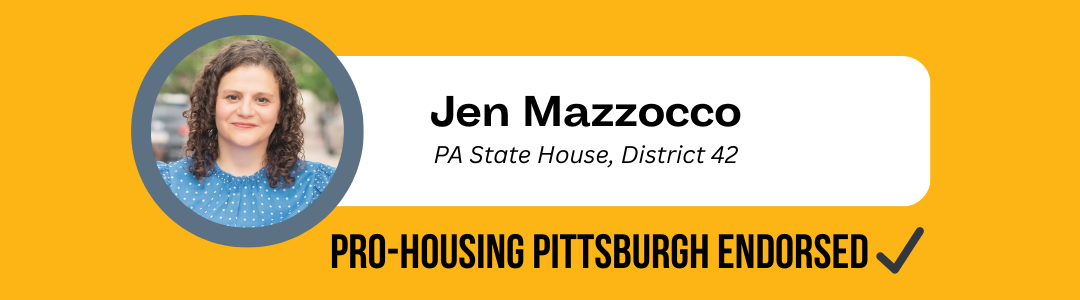
All of Jen’s responses are published in full below, and informed our official endorsement of Jen Mazzocco for House District 42.
1. What has been your personal experience with housing in the Pittsburgh metro area? Do you rent or own? If you own your home, how long ago did you buy it? Have you or do you know others who have struggled to find affordable housing in the area?
We own our home, which we purchased in 2013. We feel lucky that we were able to find a home, specifically in Dormont, before the cost of housing here skyrocketed. There are houses on our street that are listed, and sell quickly, at more than double what we paid for our home a little over a decade ago. We’ve encountered numerous friends who have tried to buy their first home, or a new home, and struggled to even get in the door because demand was so high. One of my friends spent several years searching in the city and suburbs for a home that she could both afford and wasn’t outbid on (one house she looked at had 22 offers).
2. While Pittsburgh is often heralded as one of the cheapest major metro areas in the country, housing prices have increased significantly in the area since 2020. What do you see as the largest contributing factors to the housing crisis in the Pittsburgh region? What policies would you support to fix these causes? What evidence do you have that these policies would work?
I think the largest contributing factor to the housing crisis is outdated zoning codes that are vestiges of red-lining. Even in urban areas, the current built environment would be impossible to replicate or replace because the zoning has changed to make it impossible to build. We’ve seen this in Dormont - we have streets with mixed types of housing that were re-zoned in the 1960s to accommodate single-family homes only. In 2021, we adopted a revised zoning ordinance that allows for greater density in all residential zones, creates transit-oriented development zones, allows for small retail “in the neighborhood" on collector streets, removes parking minimums, largely removes setback requirements, and allows for accessory dwelling units. We’ve seen firsthand that this revision has helped - a development that was slow moving and would have required an astronomical number of parking spaces before the rewrite is now entering the RFP phase.
3. Reps. David Solomon, John Inglis, and Greg Scott have recently proposed several bipartisan bills intended to combat Pennsylvania’s housing shortage. These bills will, among other things, prohibit municipal parking minimums, streamline the processing of housing-related permits, and define pre-approved housing plans. The specific language of each bill can be found in the links below:
https://www.palegis.us/house/co-sponsorship/memo?memoID=47700
https://www.palegis.us/house/co-sponsorship/memo?memoID=47775
https://www.palegis.us/house/co-sponsorship/memo?memoID=47776
https://www.palegis.us/house/co-sponsorship/memo?memoID=47774
https://www.palegis.us/house/co-sponsorship/memo?memoID=47550
If elected, will you commit to supporting this legislation?
Yes, I would support the above legislation.
4. Property insurance rates have increased nationwide in recent years, impacting the prices of not only single-family housing, but also apartments and condominiums. In disaster-prone states such as California, even statewide insurers of last resort are running out of money. What policies would you propose to ensure that Pennsylvania’s FAIR plan does not face the same challenges in the future?
Admittedly, I don’t know a lot about the intricacies of the FAIR plan to be able to articulate policy plans. Generally, I think it is prudent to provide insurance options to older properties, especially given the aging housing stock in our cities and the current zoning that makes it difficult to redevelop aging or blighted housing. Additionally, as climate change causes shifts in weather patterns, housing that was once in “safe” / insurable areas may be newly in areas that are not eligible for insurance, and we need to make sure people can stay in their homes while they find other options. I am willing to learn more about how we can strengthen this program.
5. What is your position on property tax reform?
I think, at the very least, we need regular reassessments at the county level so that property tax is equitably levied and is reviewed regularly to ensure that a “newcomer tax” doesn’t impact homebuyers whose properties are spot-reassessed when they sell for much higher value than the homes around them. Since we haven’t done a reassessment in 14 years, I think some kind of provision to protect low income / retired homeowners from too large a jump would be necessary. Then, regular reassessments should prevent steep increases and would more equitably distribute tax burden across properties in the county. I would support a look at how we can move to a land value tax to encourage development of land and revitalization of blighted property.
6. What books, articles, or research have you read that have informed your views on housing?
I’ve read quite a bit on mobility/walkability, and being able to have walkable neighborhoods is dependent upon density. It’s really difficult to make a sprawled suburb walkable, especially to points of interest like schools, parks, and business districts. I haven’t read any books specifically on housing, but learned a lot through the hands-on experience of our zoning code revision. Reduction in sprawl is better for reducing pollution and mitigating the effects of climate change, creates sustainable development that municipalities can handle with infrastructure and services, and benefits community building. I’ve read “Strong Towns: A Bottom Up Revolution to Rebuild American Prosperity” by Charles Marohn, “Walkable Cities: How Downtown Can Save America, One Step at a Time” by Jeff Speck, “Accessible America: A History of Disability and Design” by Bess Williamson, “The High Cost of Free Parking” by Donald Shoup, “Curbing Traffic: The Human Case for Fewer Cars in Our Lives” by Melissa and Chris Bruntlett – all of these books have informed my ideas about urban design, and though none of them focus directly on housing, they have worked in parallel to my understanding of housing development.
7. Do you have any other thoughts on housing that you would like to share with the voters of your district?
I think housing will be a key issue in PA in 2026, and I feel very equipped to handle it as a legislator given my local experience with a zoning code rewrite. I’m particularly interested in transit-oriented development since House District 42 has robust public transportation and some key opportunities to increase density around transit stops, which would help to increase ridership and keep transit viable in the district.