
How the conversion of a parking lot into apartments in Homestead lays bare the negative impacts of Pittsburgh’s current zoning code.
For this installment of You Can’t Build That Here, we head down the Three Rivers Heritage Trail, cross over the Monongahela on the Hot Metal Bridge, and follow the Great Allegheny Passage all the way to The Waterfront, where a new apartment building is going up on the riverfront by the Homestead Grays Bridge.
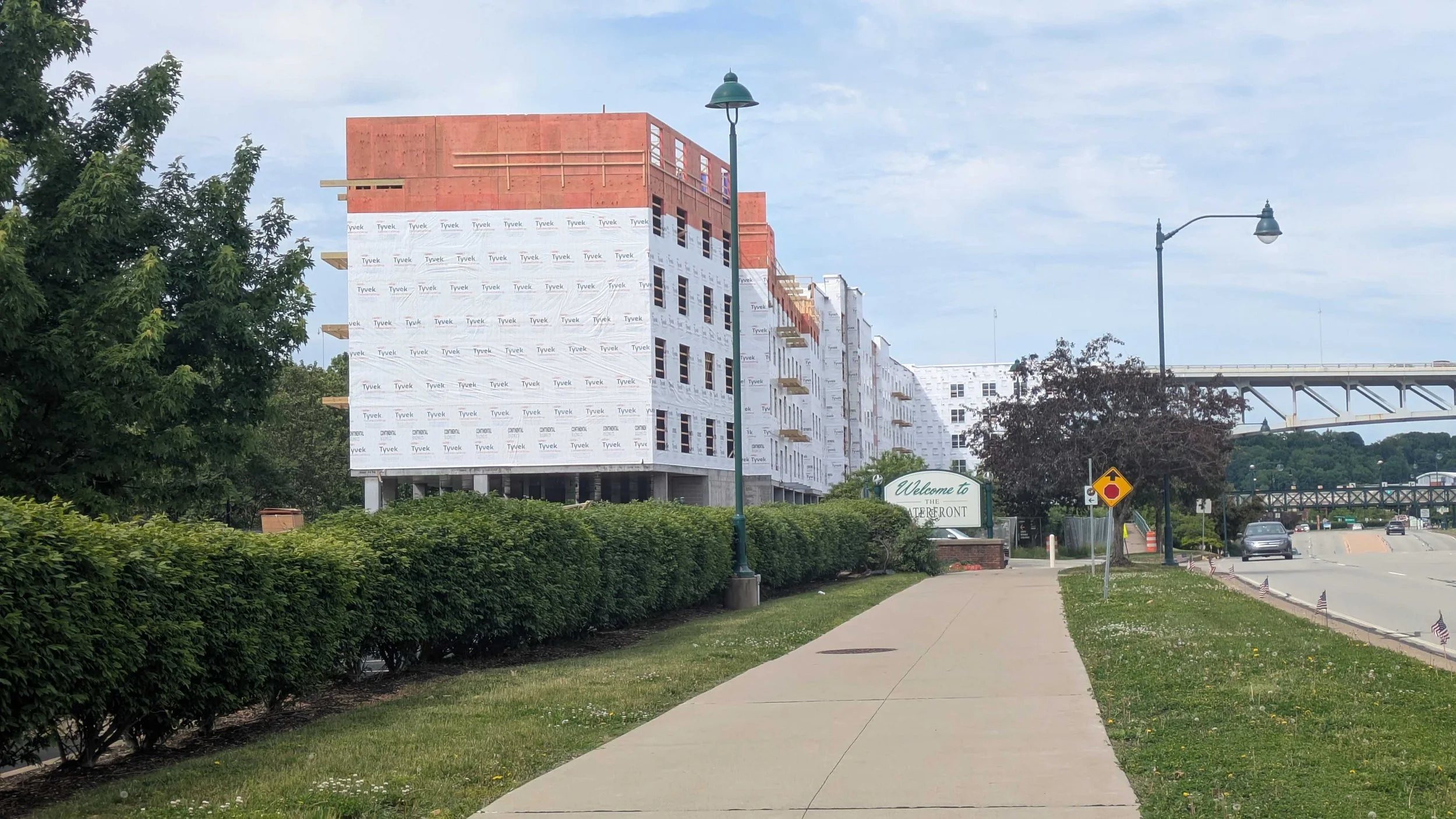
Photo credit: Amy Zaiss
Built on the site of the defunct Mitchell’s Fish Market, this building will convert three acres of mostly asphalt surface parking—a smaller footprint than some single-family lots in the suburbs—into 250 units of apartment housing. At an estimate of 1.5 people per unit, it will house 375 people, increasing the boroughs’ combined populations by a staggering eight percent without displacing a single longtime resident.
With the GAP trail literally in the building’s backyard, numerous bus stops close by, and both the Waterfront and the 8th Avenue business district a short walk or bike ride away, this is a textbook example of how infill development allows more people to access existing amenities. The fact that it is being built in The Waterfront, right between the Pittsburgh neighborhoods of Squirrel Hill South and New Homestead, demonstrates that Pittsburgh’s antiquated zoning code is hindering its ability to grow.
Land use in The Waterfront is regulated under the auspices of the Waterfront Development District, a special zoning district roughly the size of Uptown which spans the three boroughs of West Homestead, Homestead, and Munhall. In this district, multifamily housing developments can be constructed by right as long as they comply with relatively lax requirements:
Parking minimums: 1 space per bedroom or 1.5 spaces per unit, whichever is lower (the AMC across the street was renovated to free up parking spaces for this and other, similar projects).
Building heights: maximum of 7 stories or 84 feet.
Setbacks: a minimum of 30 feet from public roads and railways, 25 feet from the river, and 0 feet on all other sides.
There is no exact match to the WDD in Pittsburgh’s zoning code, but the nearest equivalent is probably RM-H, a district which occurs sporadically in neighborhoods such as Shadyside, the Hill District, and Squirrel Hill. With the exception of Summerset, one apartment complex, and a few other small planned developments, almost all buildable land in the parts of the city closest to The Waterfront is zoned as either R1 or R2, meaning that construction is limited to single-family houses or duplexes.
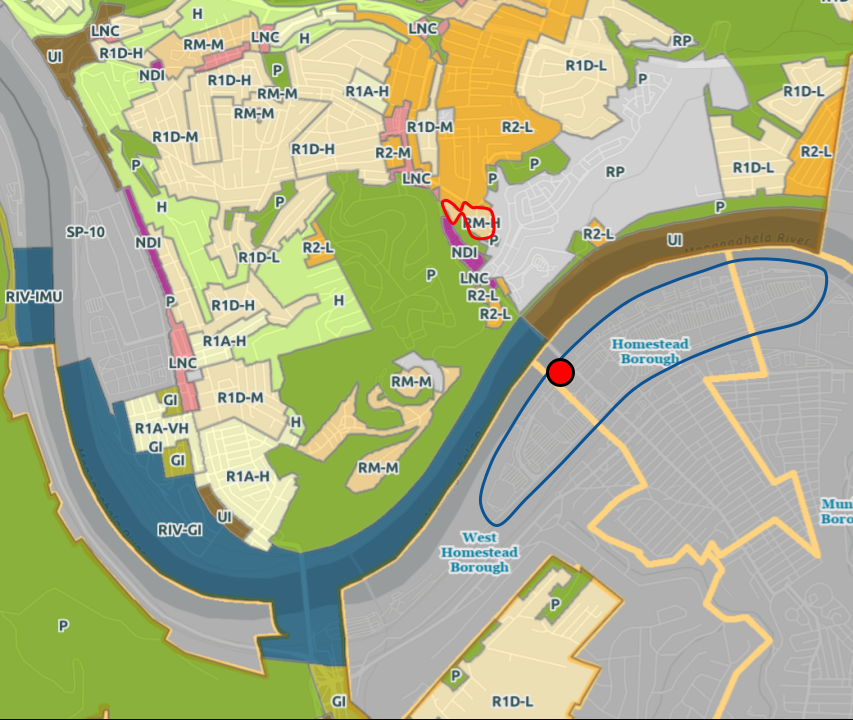
Zoning map of the largely residential neighborhoods surrounding The Waterfront. The blue line roughly marks the borders of the Waterfront Development District, while the red dot shows the location of the apartment complex. The lone instance of RM-H in the area is circled in red.
These zoning districts are restrictive enough that many existing units in this area would be illegal to build today, let alone a 250-unit apartment building. With this in mind, it is no surprise that developers are choosing to take their business outside city limits instead of applying for a variance and risking a repeat of the Irish Centre debacle.
This is just one apartment building in one inner-ring suburb, but it sheds light on a broader long-term issue. Since developers will usually build where it is easiest to do so, Pittsburgh’s zoning code has long incentivized development elsewhere. The resulting decline in the city’s tax base is at least partially responsible for its budgetary troubles and the proposed closure of several PPS schools.
But things are beginning to change. Since 2020, the City of Pittsburgh has experienced the largest numerical increase of any municipality in the Commonwealth while remaining the most affordable city in the United States. The Waterfront’s housing policy should be our model for adapting to this new reality. A bold, ambitious strategy of citywide upzoning will empower us to welcome new arrivals while keeping Pittsburgh affordable for all.
Article by Ben Lyons with contributions from Amy Zaiss
Corrections: the size of the lot is three acres, not 1.8; and the development is being constructed in both Homestead and West Homestead, not just Homestead.