It’s been a while since we’ve done one of these! For our sixteenth entry in our “You Can’t Build That Here!” series, we take a stroll down Liberty Avenue to the Cultural District.
Each entry in this series highlights a currently existing building that would be illegal to build under the existing zoning code. The purpose is to highlight how flawed our zoning code is.
The Clark Building is a historic twenty-five[1] story high-rise building at 717 Liberty Avenue, Pittsburgh, PA 15222. Named for Metro-Goldwyn-Mayer magnate James Bly Clark, the building is currently owned by PMC Property Group, which converted it into a predominantly residential apartment building in 2014. The lowest three floors are dedicated to the Pittsburgh Jewelry District and space for the adjoining Benedum Center. The building is listed on the National Register of Historic Places and is a centerpiece of the Penn-Liberty Historic District.
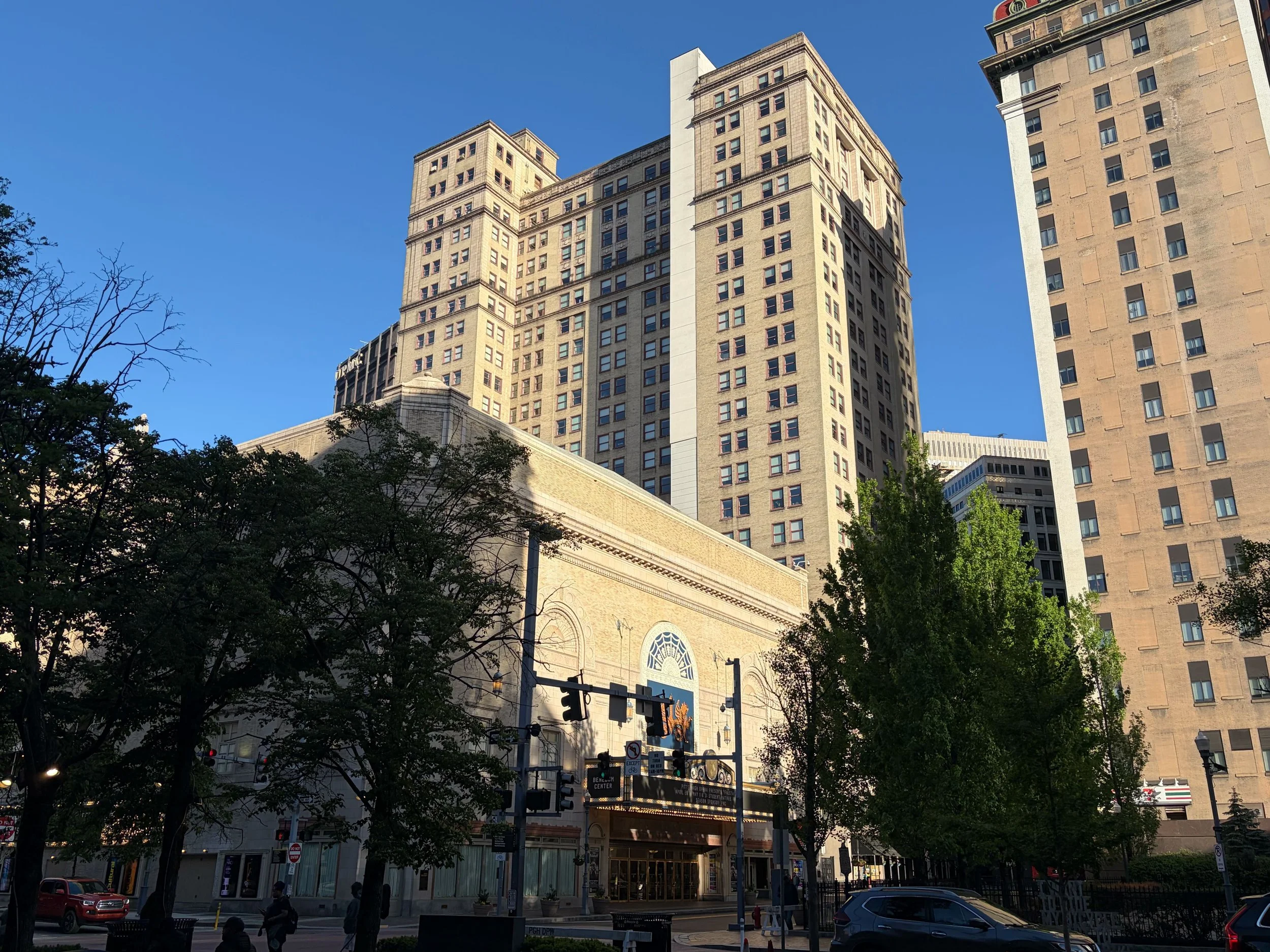
The Clark Building on a sunny April day. This century-old skyscraper provides housing to 200 Pittsburghers. Photo credit: Nick Rizzio
The Clark Building was first proposed in 1926, just three years after the first zoning ordinance in Pittsburgh was passed into law. Financed by the Stanley-Rowland-Clark Company, it was part of a combined project which included the Stanley Theatre, now known as the Bendum Center, for a cost of $10,000,000 (over $180,000,000 in 2026 dollars). But before the shovels could hit the ground, the City of Pittsburgh rejected the permit application.
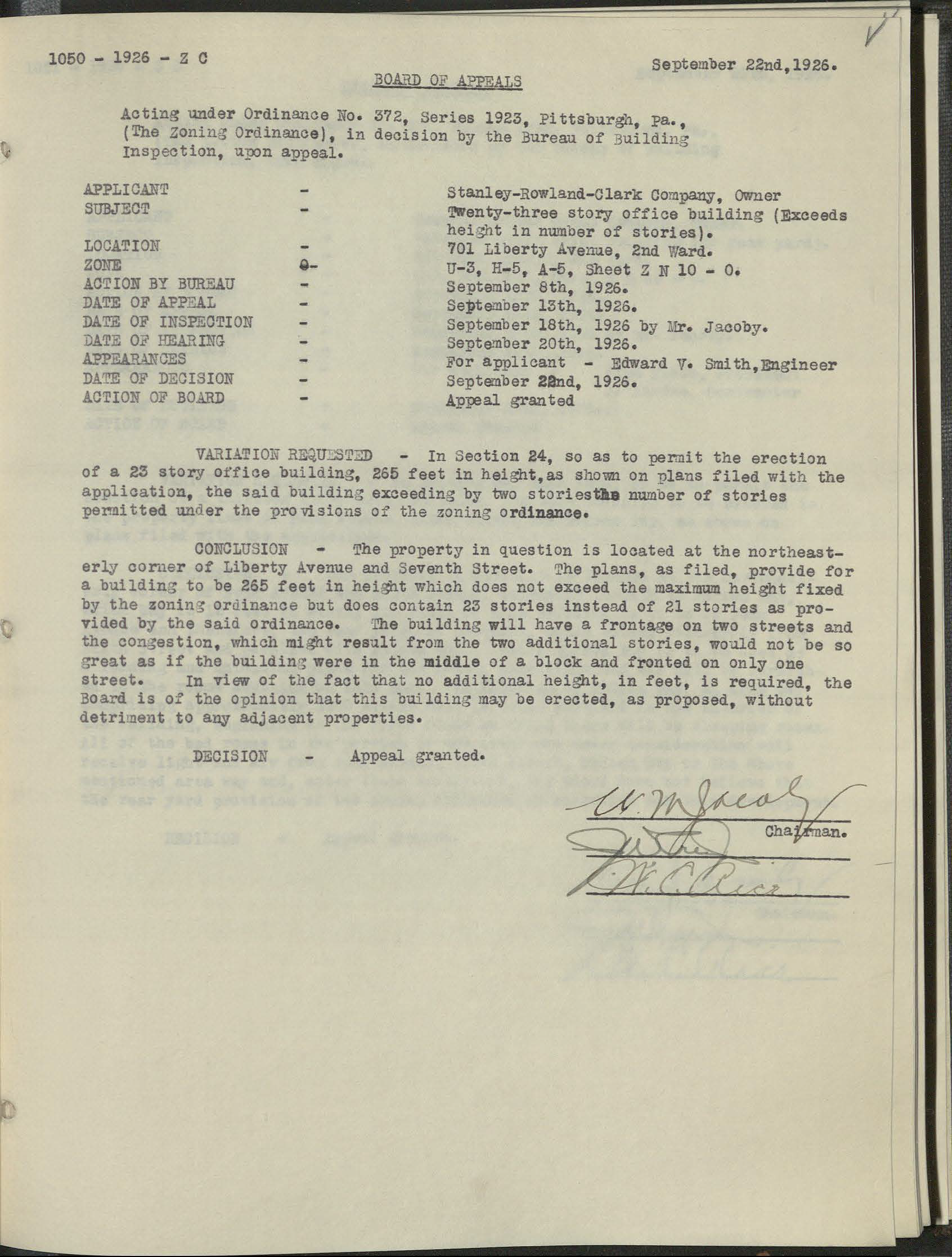
According to the Bureau of Building Inspection, the Clark Building violated the 1923 zoning ordinance because its proposed 23 stories exceeded the 21 stories allowed by code. On September 8th, 1926, the Stanley-Rowland-Clark Company appealed to the Pittsburgh Zoning Board of Appeals, and on September 20th, 1926 – just twelve days later – the Board of Appeals accepted the appeal and allowed the Clark Building and Stanley Theatre to be granted their permits. Construction began and was completed by 1928.
The reaction to the decision was swift. On September 30th, 1926, a prescient letter to the editor was published in the Pittsburgh Press. Written by an author merely attributed as J.M.R, the letter stated:
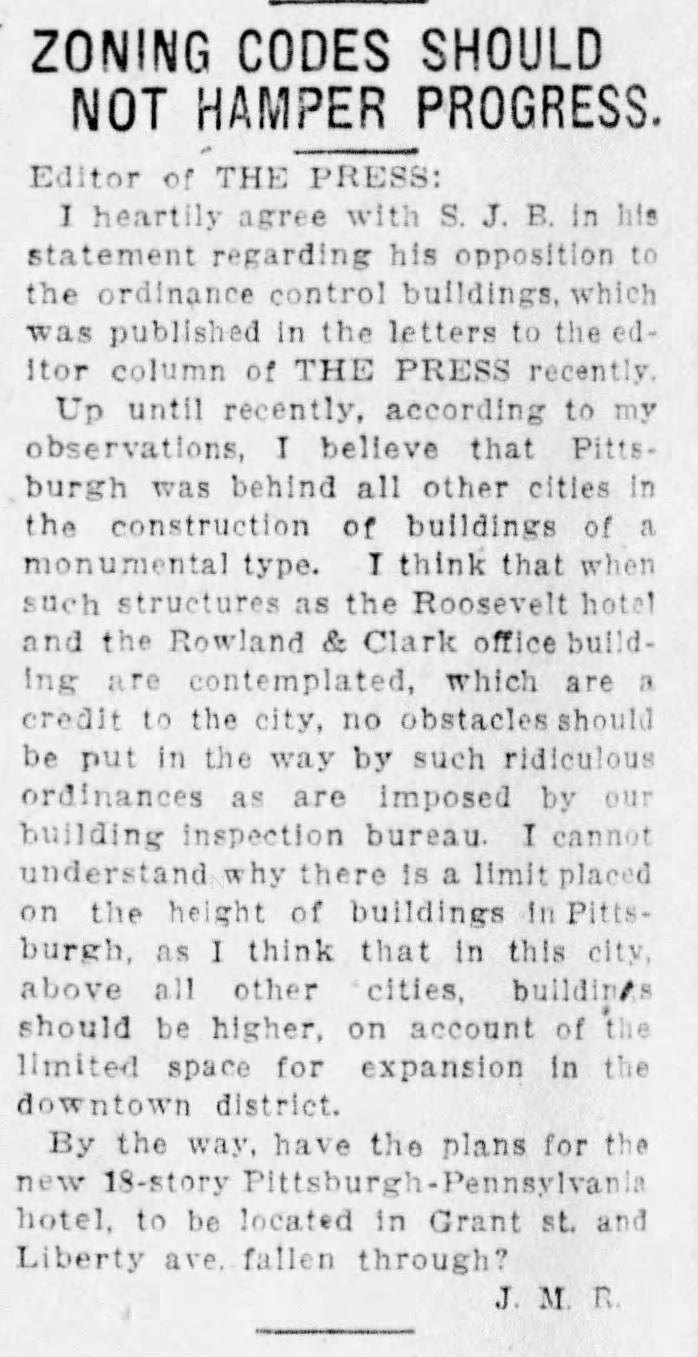
I heartily agree with S.J.B in his statement regarding his opposition to the ordinance control buildings, which was published in the letters to the editor column of THE PRESS recently.
Up until recently, according to my observations, I believe that Pittsburgh was behind all other cities in the construction of buildings of a monumental type. I think that when such structures as the Roosevelt hotel and the Rowland & Clark office building are contemplated, which are a credit to the city, no obstacles should be put in the way by such ridiculous ordinances as are imposed by our building inspection bureau.
I cannot understand why there is a limit placed on the heights of buildings in Pittsburgh, as I think that in this city, above all other cities, buildings should be higher, on account of limited space for expansion in the downtown district.
Even though the appeal only pertained to two stories, the Board of Appeal’s decision reverberates almost a century later. I am a resident of the Clark Building, and my home is on the 23rd floor – one of the two floors that the original zoning ordinance of Pittsburgh intended to forbid. It’s hard to contemplate the idea that but for the goodwill of three political appointees who have long since passed on, my current home would not have been built.
One would hope that with the passage of time, our zoning code has become more enlightened. But the modern zoning code, originally passed in 1998, is even more restrictive than before. The Clark Building is zoned “GT-C” - Golden Triangle, subdistrict C. Here, buildings are restricted to have a Floor Area Ratio (FAR) of no more than 10. That means the building’s square footage cannot be more than 10 times that of its lot size. The Clark Building, on parcel 1-D-66, has a lot size of 16,181 square feet. It has a building square footage of 291,000 square feet. In other words, it has a FAR of >17, far more than the 10 allowed. It is non-conforming with the current code and could not be built today.
Two dozen residents live on the 22nd and 23rd floors, and over 200 people live in the building overall. Thousands of people have taken in the panoramic views of the city on the roof deck, the place where I watched the 2024 partial solar eclipse. My neighbors and I never had the chance to appear before the Board of Appeals and advocate for our interests – none of my ancestors had even come to the United States when the hearing was heard. That’s the risk and the cost of exclusionary zoning.
If celebrated historic buildings like the Clark Building violated the zoning rules of their own time, then what kind of progress is our current zoning code holding back today? Just a few weeks ago, the Zoning Board denied a request for a variance to have a paltry FAR of 10 in the Strip District, at the corner of 17th and Penn, less than a mile away from the Clark Building. 100 years later, our ears must burn when we hear J.M.R.’s words:
“I cannot understand why there is a limit placed on the heights of buildings in Pittsburgh”
By Nick Rizzio with contributions from Jack Billings.
[1] The Clark Building has 23 full floors. PMC Property Group converted space on the 24th floor to a gym and added a roof deck to what is now known as the 25th floor.