On November 12, 2026, the Urban Redevelopment Authority of Pittsburgh (URA) Board of Directors approved a $3 million rental gap loan and the land sale for McCormack Baron Salazar's 44-unit North Homewood (formerly Homewood Gateway) apartments. It also approved the land sale for 52 affordable senior apartments on the former Berg Place site in Carrick, and a $900,000 grant to rehab nine Bedford Avenue row houses in the Hill District for first-time buyers. The board also approved the Housing Opportunity Fund's $14.9 million 2027 allocation plan, which now goes to City Council, while staff warned about the mayor's proposed cuts to the fund. Four of the five board members took part, and every item passed on a voice vote with no audible opposition. Here's what happened, item by item.
Recording: https://www.youtube.com/watch?v=c_0jTCodlV0
Development Services
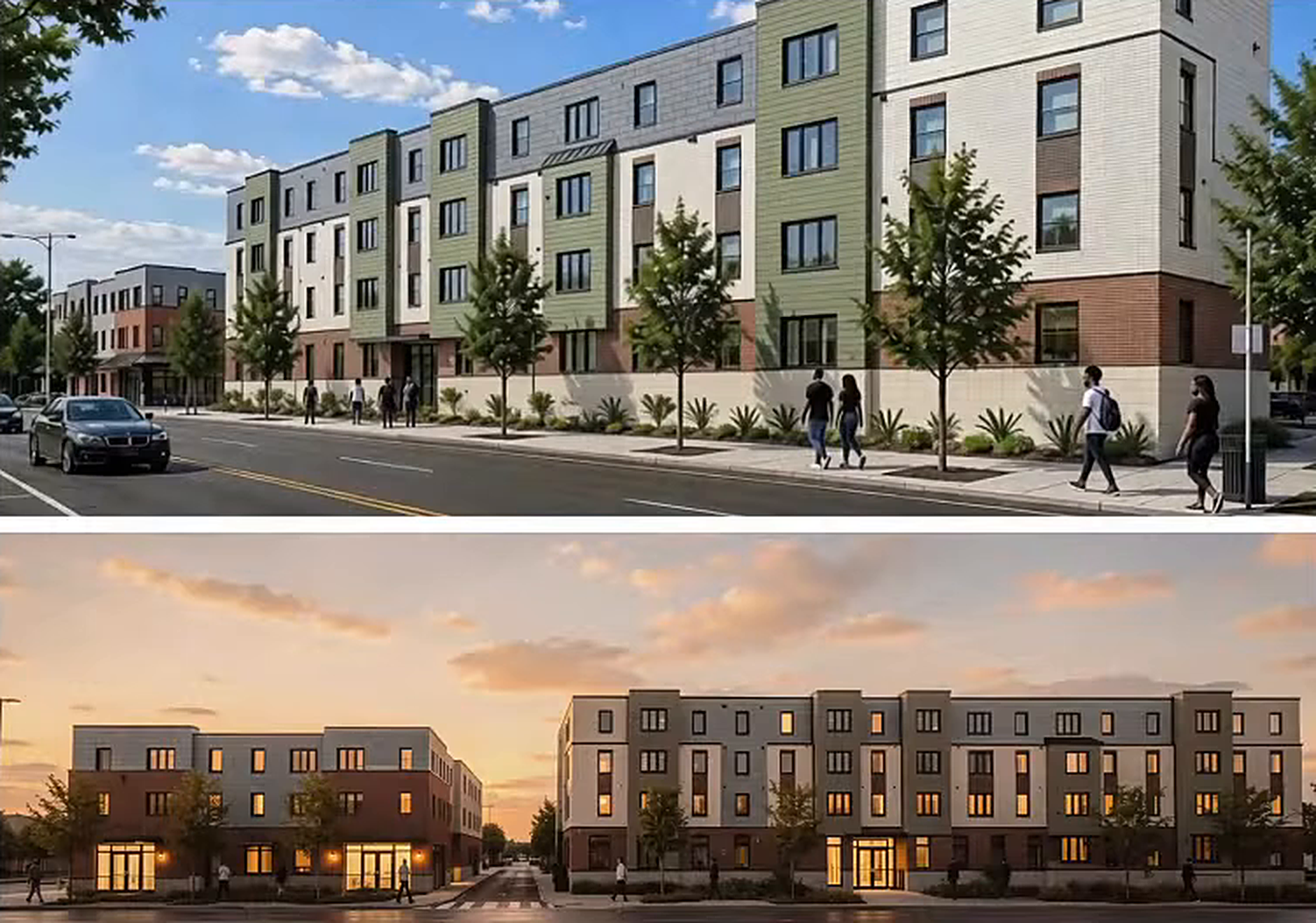
North Homewood (formerly Homewood Gateway) — North Homewood Avenue (Homewood South)
URA materials: Director's report and resolutions
Summary of Item
The board was asked to approve three related items for McCormack Baron Salazar's North Homewood project: a waiver letting the Rental Gap Program (RGP) loan exceed its usual $2 million cap, an RGP loan of up to $3 million, and final drawings, final evidence of financing, and a deed for six URA lots plus a vacated piece of Cassina Way, sold for $176,000 plus costs. The site runs along North Homewood Avenue between Susquehanna Street and Hamilton Avenue.
The project is two new three- and four-story buildings with 44 apartments: 16 one-bedroom, 16 two-bedroom, and 12 three-bedroom. Thirty-seven will be affordable for 40 years (6 at or below 20% of area median income (AMI), 24 at or below 50%, and 7 at or below 60%), and seven will be market rate. Nine units will be ADA-accessible elevator units and three will be sensory-accessible. The first floor will have about 4,000 square feet of commercial space.
The developer won 9% low-income housing tax credits (LIHTC) from the Pennsylvania Housing Finance Agency (PHFA) in the 2024 round. Total cost is about $25.55 million. Besides the $3 million RGP loan and about $12.3 million in tax credit equity, financing includes $4.2 million in gap loans and 30 project-based vouchers from the Housing Authority of the City of Pittsburgh (HACP), a state RACP grant, federal project funding, and other URA loans. The slide shown at the meeting targeted financial closing by the end of 2026, construction starting by the second quarter of 2027, and completion in late 2028. Construction is expected to take 16 months.
Discussion
A McCormack Baron Salazar representative said the team is aiming to close sometime in December and that the remaining pieces, including PHFA, are lined up. Chair Yarone Zober called it "a very impactful corner" in an important neighborhood and noted the project has been in the works since at least its 2024 tax credit award. He pressed the team to close by year's end and break ground early next year. He also said Homewood is probably next, after Larimer and the Hill District, in terms of the sheer number of publicly owned vacant lots. He urged the developer, and the city's small pool of 10 to 15 LIHTC builders, to bring new projects to the URA's 2027 LIHTC pre-application. No public comment on this item.
Decision
Approved on a voice vote; no opposition was heard. A motion and second were heard, but the movers weren't identifiable on the recording.
In the news: McCormack Baron Salazar gets URA funding boost for $25.5M Homewood project — Pittsburgh Business Times, Nov. 12, 2026.
Carrick Senior Apartments — former Berg Place, 2535 Brownsville Road (Carrick)
URA materials: Director's report and resolution
In the news: 'A great day for Carrick' as demolition begins at blighted Berg Place to make way for senior apartments — Pittsburgh Post-Gazette, Oct. 27, 2026.
Summary of Item
The board approved the sale of this URA-owned site to Carrick Senior Apartments LP (CHN Housing Partners and Amani Christian CDC) at its September 10, 2026 meeting. This month it was asked to approve the final drawings and final evidence of financing and to execute the deed, for $280,000 including holding costs.
The project will build 52 affordable one- and two-bedroom apartments for seniors where the long-vacant Berg Place apartments are now being demolished. All 52 will be affordable for 40 years (6 at or below 20% of AMI, 44 at or below 50%, and 2 at or below 80%), and 50 will have HACP project-based vouchers. Nine units will meet federal (UFAS) accessibility standards and two will be sensory units. Total cost is about $24.9 million, funded mainly by about $15.9 million in 9% LIHTC equity, a $2.45 million URA rental gap loan, a First National Bank mortgage, HACP funds, and a PHFA PHARE loan. Construction is expected to take 16 to 18 months once demolition is finished, which staff said could take one to six months.
Discussion
A CHN Housing Partners representative thanked URA staff for getting the project to this point. Zober noted that the demolition had just begun with "great fanfare." He said the project took about two years from inception, which shows how long projects with complicated financing take. As with the Homewood team, he urged CHN and Amani to have another project ready for the LIHTC pre-application deadline. No public comment on this item.
Decision
Approved on a voice vote; no opposition was heard. The chair said he heard a motion and a second; the movers weren't identifiable on the recording.
Housing
Bedford Townhomes — 2700 block of Bedford Avenue (Bedford Dwellings / Hill District)
URA materials: Director's report and resolution
Summary of Item
The board was asked to approve a For-Sale Development Program (FSDP) grant of up to $900,000, funded with federal CDBG money, to the Pittsburgh Housing Development Corporation (PHDC), the URA's nonprofit affiliate. The grant will help PHDC buy and fully rehab nine attached two-bedroom row houses at 2702–2728 Bedford Avenue. All nine will be sold to buyers at or below 80% of AMI, with 30-year affordability restrictions. Total cost is about $5.27 million, with the rest coming from HUD Choice Neighborhoods funds, a Dollar Bank line of credit, an HACP deferred mortgage, City CDBG funds, and Hill CDC PHARE awards. Construction is expected to start in December 2026 and take 12 months. The project is part of the Bedford Dwellings Choice Neighborhoods plan.
Discussion
PHDC's housing development manager said the project will also fund roof and façade work on six privately owned homes on the block, which he called one of the few intact rows of row houses left in the Greater Hill District. He credited the longtime homeowners who stayed on the block through years of vacancy next door. The homes date to about 1910. The Hill CDC acquired five from the City, the Pittsburgh Land Bank three, and PHDC one from a private seller. Renovation runs about $425,000 per home, in part because three are collapsed into their basements behind standing brick façades. The target sale price is about $195,000, with a deferred second mortgage of about $60,000. That puts the buyer's real price at about $135,000.
Zober said both his great-grandparents had lived on Bedford Avenue. He argued that saving homes like these, even at this cost, compares well with new construction and keeps "the charm" that "makes Pittsburgh Pittsburgh." He told PHDC and the Hill CDC to "find more of these." URA staff added that the URA runs the neighborhood programs under HACP's Choice Neighborhoods award, and more acquisition-and-rehab projects along Bedford Avenue are planned. No public comment on this item.
Decision
Approved on a voice vote; no opposition was heard. A motion and second were heard, but the movers weren't identifiable on the recording.
Housing Opportunity Fund (HOF) 2027 Annual Allocation Plan
URA materials: Director's report, allocation table, and resolution
Summary of Item
The board was asked to approve the 2027 spending plan for the Housing Opportunity Fund, the City's affordable housing trust fund, which the URA runs. The plan was drafted by the HOF's 17-member, mayor-appointed advisory board. For the first time, the plan spends interest and loan repayments that built up in the fund from 2018 through 2025 on top of the usual $10 million a year. The total is $14,883,713: $10 million from the annual allocation, $3.85 million in interest, and $1.03 million in repayments.
The biggest share, $6.82 million, goes to the Rental Gap Program. The rest goes to Housing Stabilization ($2.04 million), tenant legal assistance ($1.57 million), the Homeowner Assistance Program (HAP) for home repairs ($1.25 million), down payment and closing cost assistance ($627,000), for-sale development ($627,000), and homeowner legal assistance ($470,000), plus $1.49 million for administration. Nothing goes to the Demonstration Dollars program or the Small Landlord Fund. The URA got 642 survey responses and 29 public comments on the draft. City Council has final approval.
Chief Housing Officer Quianna Wasler said the mayor's preliminary 2027 budget proposes "reimagining" the HOF. The URA will keep working with the mayor's office and City Council before the capital budget is finalized in December.
Discussion
State Rep. Lindsay Powell called the HOF one of the URA's "crowning jewels" and asked how programs would work if the fund is cut significantly. Wasler said the fund helped 20 households buy homes last quarter, so a cut could mean about 100 fewer affordable home purchases a year. She called rental gap the URA's main tool for creating affordable units at scale and HAP the broadest home repair program left, since the state didn't fund its whole-home repairs program. She said the URA has started looking at fundraising to fill gaps. Executive Director Susheela Nemani-Stanger said the City budget as written gives the URA $7.8 million less overall, which also limits its ability to leverage state and federal money. She welcomed a new $4 million flexible "URA programming" line in the City operating budget but said she wished it were higher.
In public comment earlier in the meeting, Raymond Moore of the Fair Housing Partnership of Greater Pittsburgh said rental gap is nearly half of each proposed HOF budget. If no 2027 money goes to the HOF, he warned, about $6 million previously set aside for HAP would likely be moved to rental gap, despite thousands of homeowners on the HAP waiting list. He added that down payment assistance, the only HOF program serving households up to 115% of AMI, would be funded at its lowest level since the fund began.
Decision
Approved on a voice vote; no opposition was heard. A motion and second were heard, but the movers weren't identifiable on the recording.
Also on the Agenda
Public Comment
Dr. Kimberly Ellis of the Historic Hill Institute made her third appearance about the Greater Hill District Neighborhood Reinvestment Fund. She said $7.18 million went into the fund in 2021 but development money didn't go out until March 2026, and that applicants were treated inconsistently. She said the advisory board never held a meeting it voted in March to hold, and that she was removed from the advisory board four days after speaking to this board in September. She asked for an investigation into a proposed $27,000 commitment she said was advanced without URA approval, repeated her call for an advisory board co-chair to resign, and asked for written responses within 15 days. The board did not respond during the meeting.
Announcements
Staff announced several efforts to move URA-owned land: an RFP for on-call construction firms to prepare vacant public lots for development (released November 16, due February 1, 2027, with a virtual pre-proposal meeting on December 7), and a rolling RFQ for commercial real estate brokers to market URA properties, opening December 1. Chief Development Officer Tom Link said two last parcels at the Pittsburgh Technology Center, about 1.5 acres (appraised at $990,000) and 1.3 acres (just over $1 million), are now on a rolling RFP. So is a nearly 8-acre riverfront site zoned for mixed use at South 18th Street and South Riverside Mews in the South Side Flats. Zober tied these together as a push to put land the URA and City already own back on the tax rolls, using brokers the way private owners do. He also pointed to renovated URA buildings in Uptown on the bus rapid transit line that are ready to sell.
Wasler announced that the URA's 2027 LIHTC pre-application deadline was extended to December 18, 2026, at 4 p.m. Only prioritized projects will receive rental gap commitment letters this year. Nemani-Stanger marked the URA's 80th anniversary on November 18. Staff also presented the Q3 2026 impact report: 20 households helped to buy homes through the HOF, 97 people helped to stay in their homes, 59 housing units created or preserved, and 12 small business loans worth more than $835,000.
Consent Agenda
Approved as a package on a voice vote. It included the sale of the 401 Technology Drive parking garage at the Pittsburgh Technology Center to The University Financing Foundation for $5.6 million, and additions of the vacated part of Cassina Way to the North Homewood deal (accepting it for $990 and amending the earlier McCormack Baron Salazar sale resolution). It also rescinded a lease for 1096 Goodman Street with Capital Good Fund and approved two Pittsburgh Land Bank lot transfers with certificates of completion and a $1 rear-yard sale on Kincaid Street.
Minutes and Roll Call
The board approved the October 8, 2026 minutes. Present: Chair Yarone Zober, Treasurer and Councilmember Bob Charland (remote), State Rep. Lindsay Powell (remote), and Vice Chair and Council President R. Daniel Lavelle (remote, joined during public comment, after the minutes vote). Absent: Sam Williamson.
Summary prepared with the assistance of AI from the public YouTube recording. This is not an official City of Pittsburgh record.